
Running a Sex Offender Check in Sabine County
The main official channel is the Texas Public Sex Offender Registry, which the Texas Department of Public Safety maintains. It supports both identity and geographic searches. A name search is useful when the person is known. A county, city, ZIP, address, or radius search is better for Sabine County community awareness. Use enough details to distinguish similar names, and read the full profile instead of relying on one row in a result list.
The Sabine County sheriff is the local point of contact for county registration and compliance questions. Sabine County does not publish a separate registration-office address, appointment schedule, or direct registry counter. Call (409) 787-2266 before a visit and ask where registry appointments are handled. The National Sex Offender Public Website, or NSOPW, adds a national check when a search extends beyond Texas.
The DPS registry search screen shows the official starting point for a Sabine County sex offender check.
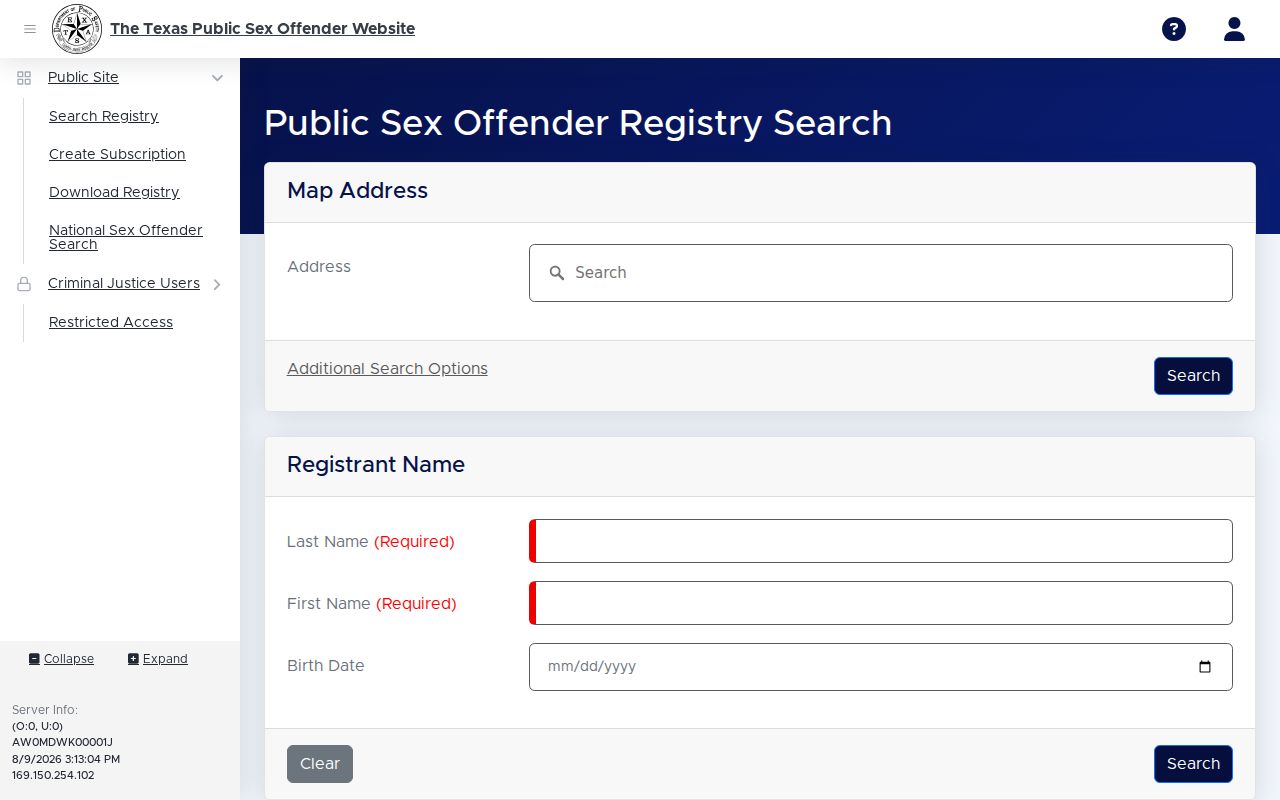
Its separate name and place fields let a reader choose the search method that fits the safety question.
Sabine County Registry Search Near Toledo Bend
Sabine County reaches the Louisiana line along the Sabine River and Toledo Bend Reservoir. That border makes search scope important. Selecting Sabine as the county can find Texas records tied to this county, while an address-and-radius search focuses on a smaller area around a home, road, or other point. Neither method alone covers the Louisiana side of the lake. NSOPW supplies the broader participating-jurisdiction layer.
Geocoding is not perfect in a rural county. Long roads, mailing addresses, and map placement can produce results that need a closer look. Compare the profile address text, city, ZIP, verifying agency, and status. Do not assume a pin marks a person's current physical location. If a listed Sabine County address seems wrong, save the profile details and report the concern to the registering agency or DPS.
Searching the Texas Public Sex Offender Registry
Begin at the official DPS interface and accept its conditions of use. The portal controls whether a partial name, address, or radius option is available at the time of the search. A careful Sabine County registry search uses the fields as filters, not as proof that two similar Sabine County entries refer to the same person.
- Open the DPS registry search and read the conditions and public-safety warning before proceeding.
- Choose a name search or enter an address, city, ZIP, county, and available radius for a place-based check.
- Review the result list and compare identifiers. Do not match on a name or map point alone.
- Open the complete profile, note its status and verifying agency, and report a suspected error through an official channel.
The fields captured in the Sabine County research show how the two search routes differ. Portal labels and radius choices can change, so use the live form as the final authority.
| Field Label | Type | Required | Notes |
|---|---|---|---|
| Last Name | Text | Name route | Exact or partial behavior is set by DPS. |
| First Name | Text | Optional | Helps narrow similar surnames. |
| Address | Text | Place route | Used for street geocoding. |
| City | Text or list | Place route | Use Hemphill or Pineland when apt. |
| County | List | Optional | Select Sabine for a county filter. |
| ZIP Code | Text | Optional | Uses a five-digit location. |
| Radius | List | Address route | Use the mile choices shown live. |
| Search / Reset | Buttons | Action | Returns or clears the list and map. |
Sabine County Offender Records Across State Lines
NSOPW is run by the U.S. Department of Justice as a search layer across participating jurisdictions. It is helpful when a person may have moved, when the relevant address lies across the Louisiana border, or when a Sabine County search needs a national cross-check. It does not replace the Texas profile. Open the source registry result when one appears, since the state record supplies the details and status reported by the responsible jurisdiction.
The official NSOPW search illustrates this second geographic layer for Sabine County border-area research.
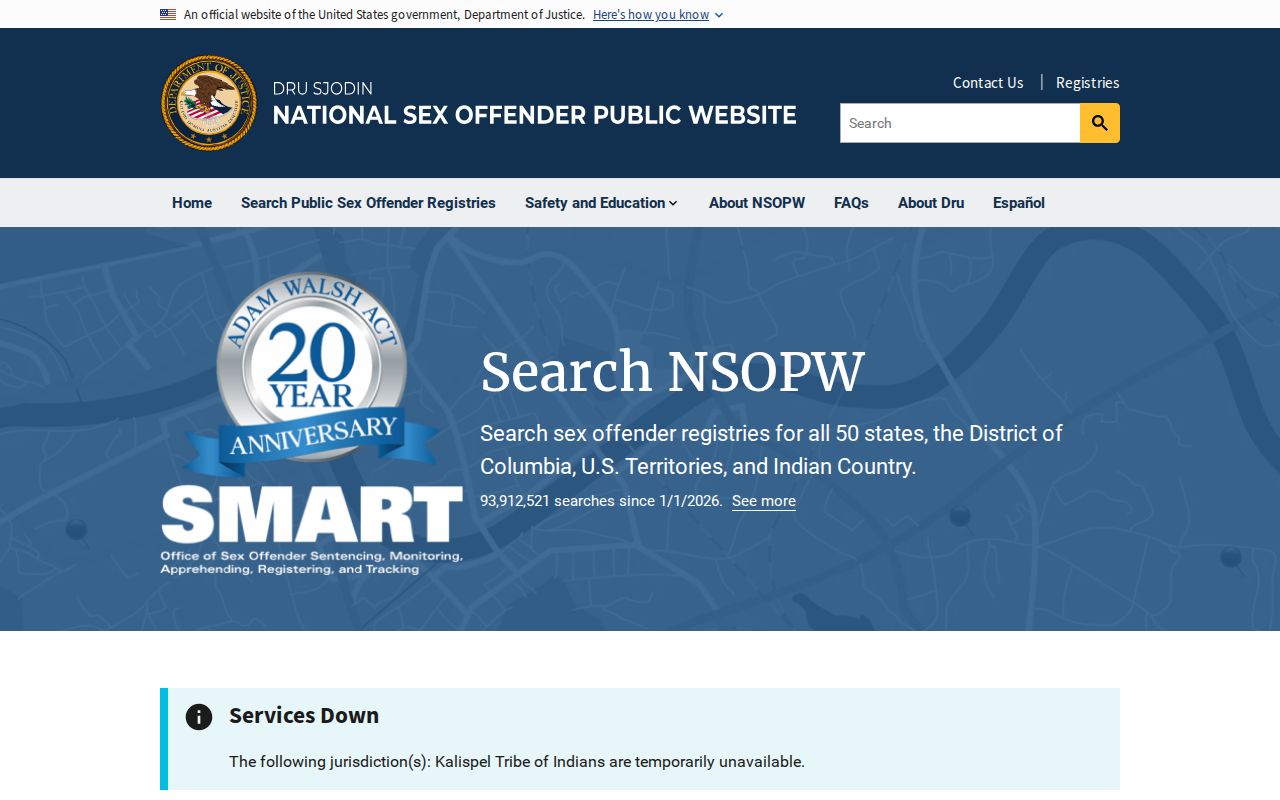
For border-area research, compare the national hit with the Texas DPS registry rather than treating the two result sets as duplicates.
What a Registry Profile Shows
A public Texas profile combines identity, address, registration, and offense fields for a Sabine County result. Some items held by law enforcement are not public. A blank public field does not prove the agency lacks the information. Read status and verification details beside the address, because a photograph or physical description alone cannot establish current compliance or present location.
| Name and aliases | Reported name forms used to separate similar identities. |
|---|---|
| Photo and description | Photograph plus age or birth display, sex, race, height, weight, hair, and eye details when public. |
| Registered address | Reported address and address status, read with the map and verifying agency. |
| Offense and case | Offense description or statute, adjudication date, and court or institution fields when released. |
| Marks and vehicles | Scars, marks, tattoos, and vehicle information when Texas law makes them public. |
| Registry status | Compliance or registration status, risk level if reported, verifying agency, and verification dates. |
Note: Registry status reflects reported and verified data, but it is not a guarantee of where a person is at the moment of review.
Wrong Sabine County Registry Addresses
An address mismatch calls for documentation and an official report. First confirm that the profile is the right one by checking aliases and other public identifiers. Next, read the address status, last verification details, and verifying agency. A rural mailing address, map placement issue, or recent report can explain what looks like an error. The public should not visit the address or confront a listed person.
For a Sabine County compliance concern, call the sheriff at (409) 787-2266 and ask for the registration contact. DPS also maintains the statewide program. Give the Sabine County profile identifier or exact name, the address shown, and a plain account of the suspected mismatch. Call 911 only for an emergency, not for a routine registry correction.
Sabine County Sheriff
P.O. Box 848
Hemphill, TX 75948
(409) 787-2266
Call to confirm the registration appointment site and hours.
Registration Requirements and Levels in Texas
Texas Chapter 62 does not fit a simple federal Tier I, Tier II, and Tier III chart with fixed public terms. The duty and duration in a Sabine County case turn on the Texas reportable offense, the judgment, and special rules that may apply. Many reportable convictions require registration for life. Other reportable matters use a statutory period tied to supervision or release. Juvenile and early-termination provisions follow their own requirements.
| Texas category | Duration framework | Public visibility |
|---|---|---|
| Lifetime reportable offense | Lifetime registration when Chapter 62 assigns that duty | Public fields appear as Texas law permits. |
| Other adult reportable matter | Offense-specific term set by Chapter 62, often tied to supervision or release | Depends on the governing Texas provision and status. |
| Juvenile or early-termination matter | Separate statutory rules and court process may apply | Not resolved by an adult federal tier label. |
The current text of Texas Code of Criminal Procedure Chapter 62 is the right source for the duty tied to a specific case.
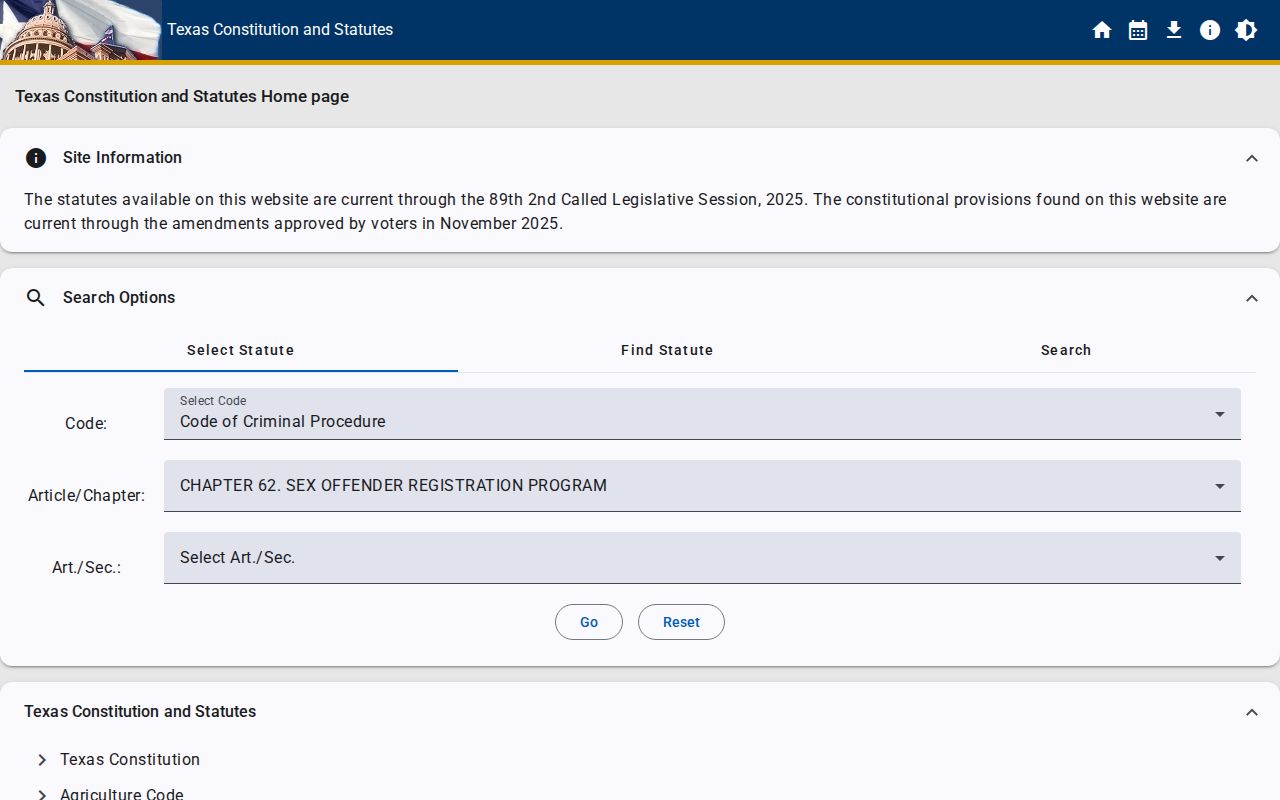
The statute shows why a Sabine County registry term should be checked against the actual offense and judgment, not a borrowed three-tier chart.
Texas Rules Behind Sabine County Registration
DPS administers the statewide registration program and provides guidance to the agencies that register and verify people under Chapter 62. The Sabine County agency handles local reports and compliance work, while DPS publishes the state registry. That split explains why a public search question goes to the registry, but an appointment, verification, or suspected failure to comply belongs with the registering law-enforcement agency.
The DPS registration-program page shows the state program behind Sabine County entries.
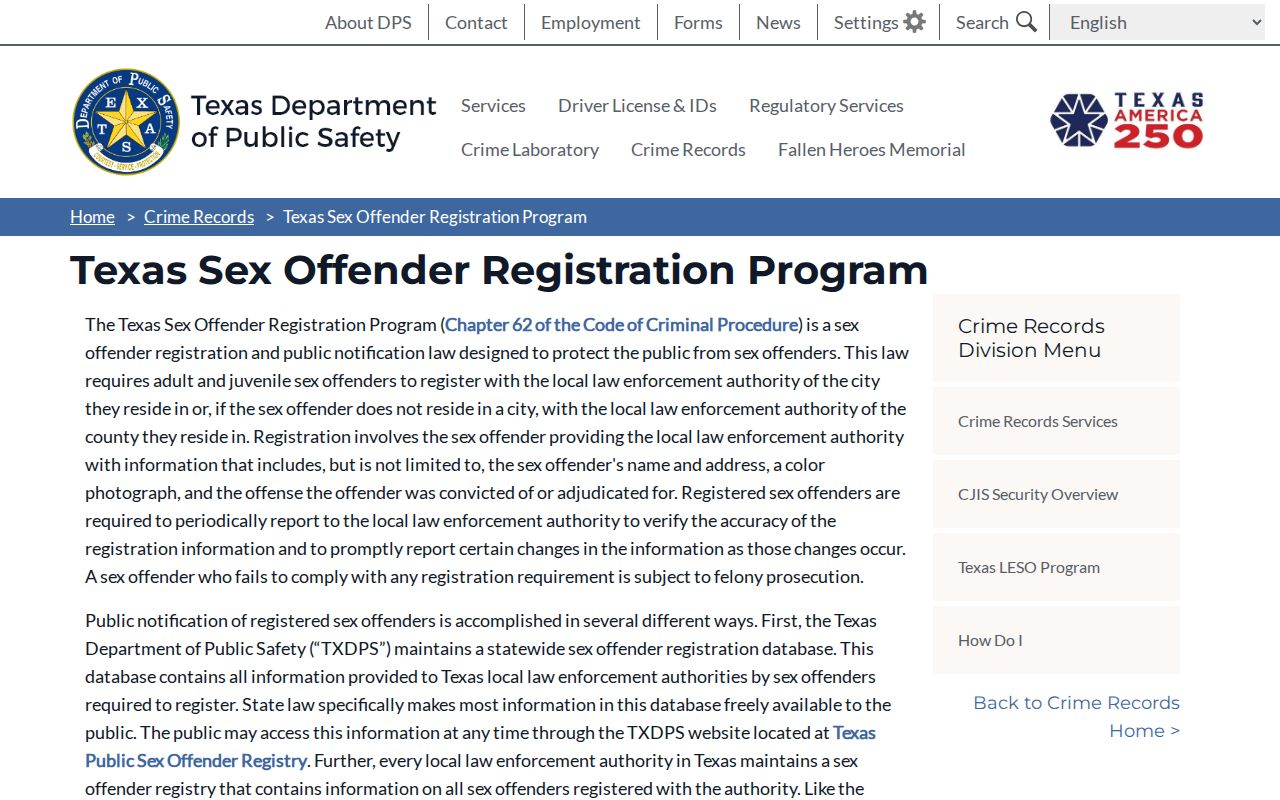
This state guidance is distinct from the public search form and helps explain the legal and agency framework behind a profile.
Reporting Sabine County Registry Noncompliance
Suspected noncompliance is a law-enforcement matter. Record what the public profile shows and explain the specific issue without trying to investigate the person. The Sabine County sheriff can route county registration concerns, while DPS manages the statewide registry program. A report may lead the agency to compare nonpublic records, verification dates, or recent changes that a public user cannot see.
This distinction protects both public safety and accuracy. A stale map point, a similar name, or an address that does not geocode well is not proof of a crime. The right step is a concise report to the registering agency. The wrong step is confrontation, publication of unsupported claims, or an attempt to track a person's movements.
Lawful Use and Community Notification
Registry access supports personal, family, and community safety. It can help a resident understand reported addresses near a location, check a known name, or follow a public notice. It does not authorize threats, injury, intimidation, or harassment. Profile data can also change, so significant concerns should be confirmed through DPS or the registering agency.
Use registry data lawfully: Texas Code of Criminal Procedure Chapter 62 governs registry use, and misuse to harass, threaten, or injure can be a crime.
For broader context on how registry records differ from court files and arrest records, the Sabine County criminal history overview explains which office keeps each type. Keep any registry review tied to lawful awareness. Report errors or suspected violations through official channels and let law enforcement assess the facts.